

The days of players buying a game, building memories around it, and then watching it vanish forever could be facing their first serious legal challenge.
California’s State Assembly has passed AB 1921, better known as the “Protect Our Games Act,” a new bill designed to stop publishers from shutting down paid digital games without giving players a way to keep playing — or get their money back.
For years, gamers have complained that digital ownership has become a joke. You “buy” a game, accept a long terms-of-service agreement nobody reads, and then years later the publisher can pull the plug on servers, authentication systems, or required online features. Suddenly, the game you paid for is gone.
Now, California is asking the question players have been shouting for years:
If you paid for it, should a company really be allowed to destroy it?
What Happened?
According to Inven Global, California’s State Assembly passed AB 1921 on May 27 with a vote of 43 to 16. The bill now moves toward the California State Senate and would still need the governor’s signature before becoming law.
The bill would apply to digital games first sold or rereleased from January 1, 2027 onwards. If a company plans to shut down services required for the “ordinary use” of that game, it would need to give players at least 60 days’ notice.
But this is not just a warning-label bill.
The Protect Our Games Act goes further. If a paid digital game relies on a publisher-controlled service to function, the operator would need to provide one of three things when that service ends:
An alternative playable version. A patch or update that allows continued access. Or a refund equal to the full purchase price.
That last part is where the industry alarm bells start ringing.
Because this bill is not politely asking publishers to be clearer. It is saying: if you sell people a paid game, you cannot simply kill its ordinary use and walk away.

What’s the Problem?
The problem is simple: modern games are increasingly fragile.
In the past, if you bought a cartridge or disc, you could usually play it years later. You might lose multiplayer, updates, or online leaderboards, but the core game often remained playable.
Today, that is not always true.
Some games require online authentication. Some depend entirely on company servers. Some are built around live-service systems that vanish the moment a publisher decides the player base is no longer worth supporting.
The most explosive example remains Ubisoft’s The Crew.
When Ubisoft shut down servers for The Crew in 2024, the racing game became unplayable. This sparked outrage because many players had purchased the game expecting long-term access, only to discover that the game’s online requirement meant its shutdown was effectively a death sentence.
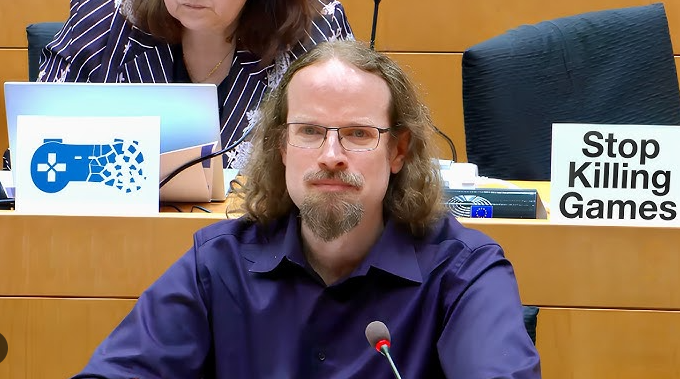
That controversy helped fuel the Stop Killing Games movement, which argues that publishers should not be allowed to sell games that can later be remotely destroyed without remedy.
As Inven Global summarised the backlash, players were left asking a brutal question:
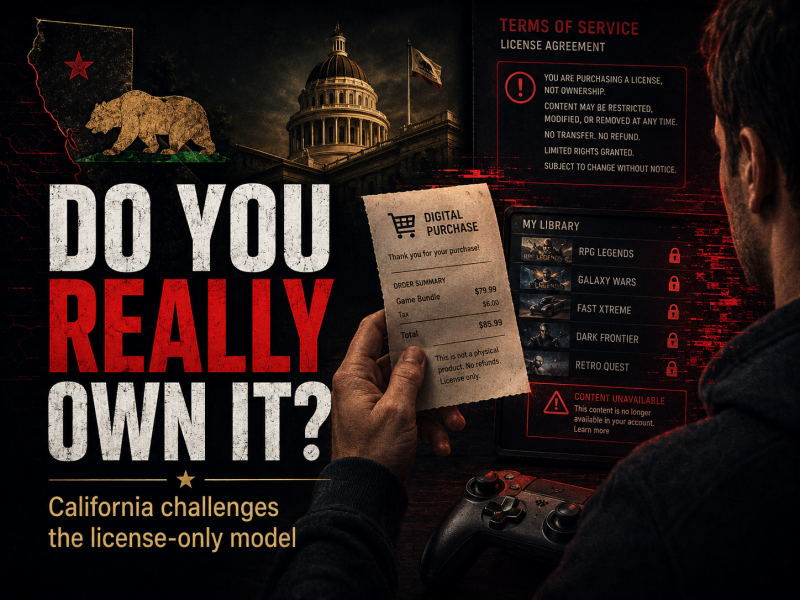
“Did we buy the game, or just a license to use it?”
That question is now at the heart of the entire debate.
The Evidence: This Bill Is Not Just Symbolic
AB 1921’s wording is unusually direct.
The bill defines a “digital game operator” as the publisher, developer, or entity that controls whether a buyer can make ordinary use of a game. That includes control over server access, authentication systems, digital rights management, or required software updates.
It also defines “ordinary use” as the buyer’s ability to use the core features of the game based on how it was advertised and sold.
That matters because it targets the exact loophole players complain about: games marketed as products but treated as revocable access once the company no longer wants to maintain them.
The bill does include exceptions. It would not apply to subscription-only services, free-to-play games offered for no monetary consideration, or games that are already permanently available offline at purchase.
So this is not a demand that every online game stay alive forever.
It is aimed at paid digital games where a publisher-controlled shutdown would make the product unusable.
That distinction is important — and it is why supporters argue the bill is more reasonable than publishers are making it sound.
Publishers Are Already Fighting Back
The Entertainment Software Association, one of the biggest industry trade groups in gaming, has pushed back strongly against AB 1921.
According to GamesRadar, the ESA argued the bill is based on what it called a “false premise” that consumers own digital games with permanent access. The group also reportedly described AB 1921 as “fundamentally flawed.”
That argument will sound familiar to anyone who has bought digital games in recent years.
Publishers often argue that players are not buying full ownership of software. They are buying a licence governed by terms and conditions. Those terms may allow companies to remove access, end services, or change functionality later.
Legally, that may be how much of the industry currently works.
But culturally, players are increasingly furious about it.
Because when a storefront uses words like “buy,” “purchase,” and “own,” most normal people assume they are getting something more permanent than temporary permission wrapped in legal language.
That is where the drama becomes bigger than one bill.
This is a fight over what digital ownership actually means.
Is There a Solution?
Yes — and AB 1921 lays out a very clear one.
The solution is not forcing companies to run servers forever. That would be unrealistic, expensive, and in some cases technically impossible.
Instead, the bill gives publishers options.
If a game is going offline, they can provide an offline version. They can release a patch that allows players to keep using the game independently. Or, if neither is possible, they can offer a refund.
That is the core appeal of the bill: it does not demand eternal support. It demands an exit plan.
Stop Killing Games organisers have made a similar point, arguing that the bill gives companies choices rather than imposing endless server costs. Their position is that paid games should not be destroyed without notice or remedy.
In other words, if a publisher wants to sell a game that depends on centralised services, it should plan for what happens when those services end.
That might change how games are built.
Developers may need to design offline fallbacks earlier. Publishers may need clearer end-of-life policies. Store pages may need to be more honest about whether a game can survive without company servers.
And yes, some companies may hate that.
But for players, that is exactly the point.
Could This Change Gaming Beyond California?
Absolutely.
California is home to major gaming and tech companies, and laws passed there often influence wider business behaviour across the United States and beyond.
If AB 1921 becomes law, it may be easier for publishers to adjust policies broadly rather than create separate rules just for California buyers. That could mean more transparency around digital purchases, better shutdown notices, and more pressure on companies to preserve core gameplay access.
It may also inspire similar efforts elsewhere.
The Stop Killing Games movement has already pushed the conversation into Europe and beyond. California passing a bill like this through the Assembly gives the movement something it has not always had: institutional momentum.
That does not mean the fight is over.
The bill still needs to pass the Senate and be signed by the governor. Industry lobbyists are likely to keep pushing back. Publishers will argue about costs, licensing, security, technical complexity, and whether refunds are realistic years after purchase.
But the direction of travel is clear.
Players are tired of dead games.
And lawmakers are starting to listen.
Add comment
Comments